There’s a particular kind of frustration that mid-size brands know well. You’re not the startup that ranks for nothing yet, and you’re not the enterprise with the domain authority that makes rankings almost automatic. You’re in the middle, where competition is real, resources are finite, and the question of where to invest SEO effort is genuinely difficult to answer.
One brand I worked with closely was stuck in exactly this position. Decent organic traffic, reasonable rankings for some secondary keywords, but consistently unable to break into the top positions for the terms that actually drove qualified leads. The obvious plays, more content, more links, kept producing marginal improvements without breaking through.
The shift happened when we stopped thinking about keywords and started thinking about entities.
What Entity-Based SEO Actually Changed
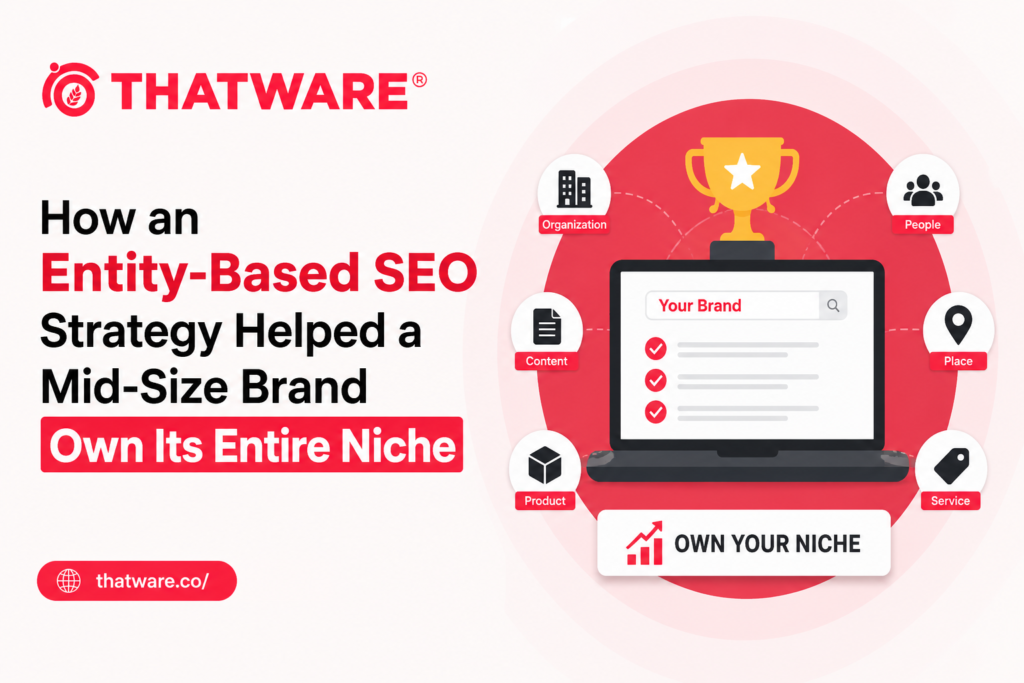
The mental model shift from keyword optimization to entity optimization changes what you’re building toward. Keywords are strings of text. Entities are things in the world: companies, people, concepts, products, places. Google’s Knowledge Graph is a map of entities and the relationships between them. When Google understands your brand as a coherent, authoritative entity within your topic area, it treats your content differently than it treats content from an unrecognized source.
For this brand, entity work started with an audit of how the brand appeared across the web. The findings were consistent with what entity audits typically reveal: inconsistent information across directories, a thin presence on authoritative external sources, structured data that was minimal and imprecise, and a general absence from the entity relationship maps in their industry.
The Knowledge Graph had a vague impression of the brand rather than a confident understanding of it. That vagueness translates directly into cautious ranking behavior. Google doesn’t confidently surface sources it doesn’t confidently understand.
Entity based seo services address this at the level of what Google actually knows about your brand, not just what your pages say about your keywords.
The Practical Work of Entity Building
Entity building is less glamorous than most SEO content suggests. It involves a lot of consistency work before it involves creative work.
The first priority was NAP consistency across all directories and external mentions. Name, address, and phone number appearing identically across hundreds of citations is a prerequisite for confident entity recognition. Inconsistencies create ambiguity, and ambiguity suppresses entity authority.
The second priority was structured data implementation across the site. Organization schema, product schema for the brand’s core offerings, Person schema for leadership, and Article schema for content. Not just implementing these, but ensuring they were accurate, complete, and consistent with what was being built externally.
The third priority was authoritative external sourcing. Getting the brand accurately described in contexts that Google treats as authoritative, industry publications, trade associations, regulatory databases where applicable, and Wikipedia-adjacent sources. This isn’t link building in the traditional sense. It’s entity confirmation: helping Google cross-reference information about the brand across sources it trusts.
The fourth priority was topical authority architecture. Building content clusters that comprehensively covered the conceptual territory the brand wanted to own, structured so that Google could understand the breadth and depth of the brand’s expertise, not just its keyword targeting.
What Changed in Rankings
The ranking improvements weren’t immediate. Entity work doesn’t produce the overnight ranking spikes that sometimes come from technical fixes or high-authority link acquisitions. It produces a different kind of movement: gradual, broad, and durable.
Over six months, rankings for the brand’s core topic cluster improved broadly, not just for specific target keywords but for related terms that hadn’t been specifically optimized. This is the signature of genuine topical authority: Google’s increased confidence in the brand as an entity in the space produces ranking improvements across the entire conceptual territory, not just for targeted keywords.
The brand also started appearing in AI-generated search responses, in Google’s AI Overviews, and in structured knowledge panels in ways that hadn’t happened before. This is entity recognition made visible: when Google understands your brand as a credible entity in a topic area, it surfaces you across the increasingly AI-mediated search landscape.
Knowledge graph seo services work builds toward this broad visibility rather than targeted keyword rankings, which is why it produces a different and more durable pattern of improvement.
The Competitive Moat That Entity Authority Creates
Here’s the aspect of entity-based SEO that makes the investment particularly attractive for mid-size brands: entity authority is hard to replicate quickly.
A competitor can copy your content strategy. They can target the same keywords, produce similar articles, and build similar link profiles. They cannot quickly replicate the entity authority you’ve built through years of consistent external representation, authoritative citations, and topical coverage depth.
Entity authority is an accumulated asset. Every mention in a credible source, every consistent citation, every piece of topical content that deepens the Knowledge Graph’s understanding of what your brand knows and does, adds to a foundation that grows more valuable over time and becomes more difficult to displace.
For a mid-size brand competing against both smaller and larger competitors, this is the kind of competitive moat that’s proportionally more accessible than it might initially appear. You don’t need a massive domain authority baseline to build entity authority. You need consistency, patience, and the right strategic priorities.
The niche ownership this brand achieved over eighteen months wasn’t the result of outspending competitors. It was the result of being better understood by Google than their competitors, which is a different kind of advantage and a more durable one.