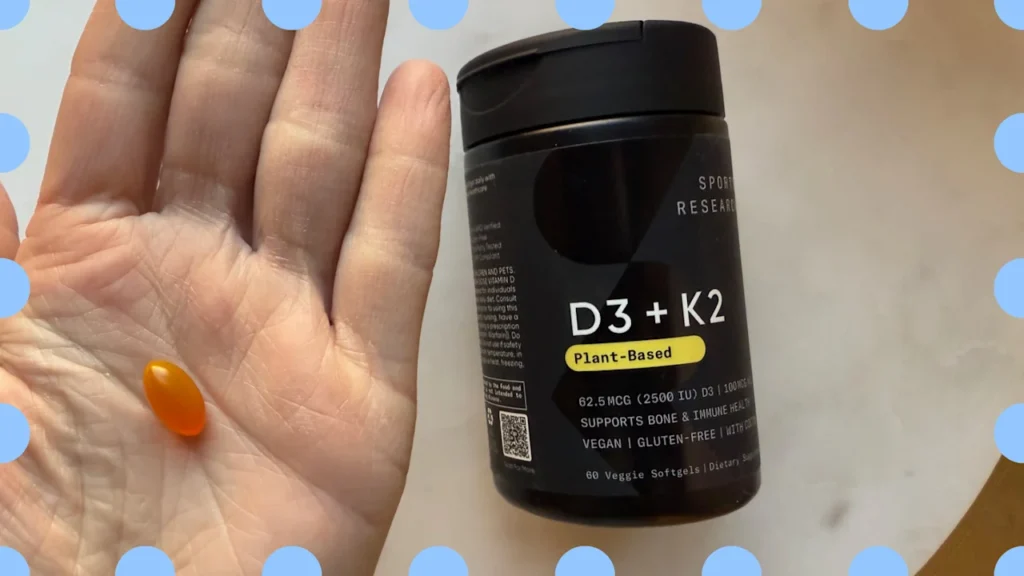
Vitamin D is one of those nutrients that seems simple until you start comparing supplements.
You might find capsules containing different doses, liquid drops, sprays, multivitamin combinations and products using different forms of vitamin D. Some are designed for daily use, while others provide substantially higher amounts intended for less frequent supplementation.
The challenge isn’t finding a bottle labelled “vitamin D.” It’s understanding which formulation makes sense for your circumstances and how to avoid taking more than you actually need.
For Australians, there is another complication: vitamin D status is influenced by factors such as sun exposure, skin pigmentation, age, lifestyle, geographic location and time spent outdoors. A supplement can be useful when dietary and environmental sources aren’t enough, but it isn’t automatically necessary for everyone.
Why Vitamin D Is Different From Most Other Vitamins
Vitamin D occupies an unusual position because the body can produce it in response to ultraviolet B (UVB) radiation from sunlight.
That means vitamin D status isn’t determined solely by what you eat.
People who spend substantial time indoors, regularly cover most of their skin, avoid direct sunlight or have other factors affecting vitamin D production may have different requirements from someone who spends considerable time outdoors.
At the same time, relying on sunlight as a precise dosing mechanism isn’t practical. UV exposure varies according to season, latitude, time of day, weather, clothing and skin characteristics. Excessive ultraviolet exposure also increases skin cancer risk.
This is why vitamin D supplementation needs to be considered separately from the general advice to maintain a balanced diet and sensible sun protection.
Choosing the Best Vitamin D Supplement Australia Has to Offer
When comparing products, start with the dose rather than the brand.
The amount of vitamin D provided per serving is one of the most important pieces of information on the label. However, a higher number isn’t necessarily evidence of a better supplement.
For many consumers, a straightforward daily product may be more practical than a very high-dose formulation. The appropriate amount depends on factors such as existing vitamin D status, age, health circumstances and whether supplementation is being used to correct an established deficiency.
A useful comparison of thebest vitamin D supplement in Australia options should therefore consider more than the headline strength. Form, dose, serving frequency, ingredients and product quality all matter.
D2 or D3? Understanding the Different Forms
One of the first details you’ll encounter when comparing vitamin D products is the distinction between vitamin D2 and vitamin D3.
Vitamin D2 is known as ergocalciferol, while vitamin D3 is cholecalciferol.
Both can increase vitamin D levels, but vitamin D3 is commonly used in supplements and is generally considered more effective at raising and maintaining circulating 25-hydroxyvitamin D concentrations.
This doesn’t mean every D3 product is automatically superior. The dose and quality of the finished product still matter.
For shoppers, the important point is simply to understand what form they’re purchasing rather than assuming every product labelled “vitamin D” is identical.
Why the Dose on the Bottle Can Be Misleading
Vitamin D supplements are often sold in micrograms (µg) or international units (IU), which can make comparisons unnecessarily confusing.
The two measurements describe the same nutrient but use different scales.
For vitamin D:
1 microgram (µg) = 40 IU.
So a product containing 25 µg provides 1,000 IU.
This conversion is worth remembering because two bottles can display apparently very different numbers while delivering exactly the same amount.
The serving size matters as well. A bottle might contain 100 capsules but provide only 50 servings if the recommended serving is two capsules.
Always compare the actual vitamin D provided per serving and the number of servings in the container.
Vitamin D Works Closely With Other Nutrients
Vitamin D doesn’t operate in isolation.
One of its best-known roles involves calcium regulation and bone health. The body needs adequate calcium and phosphorus availability to maintain normal bone mineralisation, while vitamin D helps regulate calcium absorption and metabolism.
Magnesium also participates in numerous processes involved in vitamin D metabolism.
That doesn’t mean everyone taking vitamin D should automatically add calcium, magnesium or a long list of additional supplements. It means that nutrition is interconnected, and correcting one nutrient while ignoring a broader dietary deficiency may not produce the expected result.
For most people, the foundation remains a varied diet that supplies a broad range of essential nutrients.
Should You Take Vitamin D Every Day?
There is no universal answer.
Daily supplementation can be convenient because it establishes a simple routine, but some vitamin D products are designed around larger doses taken less frequently.
The appropriate approach depends on the amount being taken, why supplementation is being used and individual circumstances.
People who have been diagnosed with vitamin D deficiency may receive specific supplementation advice from a healthcare professional. That recommendation may differ considerably from what is appropriate for someone simply looking for general nutritional support.
This is one reason copying another person’s vitamin D regimen can be problematic. A friend’s dose may have been selected to address a laboratory-confirmed deficiency, while someone else may have completely different requirements.
What to Check Before Buying a Vitamin D Product
A few minutes of label checking can eliminate most of the uncertainty.
Check the form. Determine whether the product contains vitamin D2 or D3.
Check the dose. Look at the amount per serving, not merely the number printed prominently on the packaging.
Check the units. Make sure you’re comparing IU with IU or micrograms with micrograms.
Check the serving size. Calculate how long the bottle will actually last.
Check additional ingredients. This is particularly relevant for gummies, sprays and flavoured products, which may contain sweeteners, flavourings or other excipients.
Check manufacturing information. Look for a clearly identified manufacturer, batch information and appropriate quality-control details.
Check the reason you’re taking it. General supplementation and treatment of an established deficiency are not necessarily the same thing.
This approach is much more useful than simply searching for the product with the highest dose.
Testing Can Change the Supplementation Decision
One of the most useful ways to approach vitamin D is to distinguish between guessing and measuring.
A blood test measuring 25-hydroxyvitamin D, commonly written as 25(OH)D, can provide information about vitamin D status.
That doesn’t mean everyone needs frequent testing. But when someone has symptoms, risk factors for deficiency or a specific reason to suspect inadequate vitamin D status, discussing testing with a healthcare professional can provide much better information than choosing a supplement based on assumptions.
Testing can also be relevant when someone is taking higher-dose supplementation for an extended period.
Vitamin D is fat-soluble, meaning it is stored in the body. Excessive intake can therefore cause problems, particularly when high doses are taken unnecessarily over long periods.
More isn’t automatically better.
When Supplementation Deserves Professional Guidance
For many healthy adults, vitamin D supplements are relatively straightforward. Certain situations deserve more caution, however.
People with kidney disease, disorders affecting calcium metabolism, certain gastrointestinal conditions or other medical issues may need individualised advice. The same applies to people taking medicines that can affect vitamin D or calcium metabolism.
Pregnancy and childhood also warrant age-appropriate guidance rather than simply copying an adult supplementation routine.
If vitamin D is being used to address a confirmed deficiency, the dose and duration should ideally be based on professional advice and, where appropriate, follow-up testing.
A More Sensible Way to Choose Vitamin D
The best vitamin D supplement isn’t necessarily the one with the largest dose, the most elaborate packaging or the longest ingredient list.
A better decision starts with the basics: understand whether you need supplementation, identify the form of vitamin D, compare the actual dose, check the serving size and consider the quality of the manufacturer.
From there, the right product becomes much easier to identify.
For Australians comparing the expanding range of vitamin D products, the most useful question isn’t simply “Which bottle is strongest?” It’s “Which product provides an appropriate amount of vitamin D in a formulation I can use consistently and safely?”
That shift—from maximum dose to appropriate dose—is what turns supplement shopping into an informed decision.